In the wellness industry, you don't necessarily have to think only locally, especially if you offer a premium service or product that can be competitive in several markets and has market demand. One of our international clients, active in both B2C and B2B in the wellness sector, asked us to generate leads for their products in several countries (including Hungary) with Meta ad campaigns, with particular attention to the different market conditions and segments (B2B vs. B2C).
What is lead generation, and why does it matter?
What or who is a lead, and what does lead generation mean?
A lead, a marketing term, is generally a potential prospect (a person or even a company) who shows genuine interest or an intention to buy or request a quote for a service or product. Put simply, a lead is figuratively a „raised hand”: the potential client signals interest in the offer and wants to learn more. They fill in the enquiry form or give their email address or phone number, and this is worth far more than a simple ad view, because it is the start of a concrete business relationship.
Lead generation is therefore one of the most important tools in marketing: we collect tangible prospects who can become clients, not followers or likes.
The goal is to generate as many relevant prospects as possible who can later become clients.
This can be achieved with various online and offline methods, for example online ads, content marketing, social media campaigns, webinars, attending exhibitions, or even email marketing.
The challenge: several countries, different consumer needs, strategic goals
In June we ran three active campaigns, with several ad sets and several ads within them, targeting:
- the B2C and B2B segments in Hungary,
- and international markets: UAE, Abu Dhabi, Germany, Austria, Slovenia, Slovakia, Poland, Croatia, Malta, Scandinavia, etc.
While in Hungary we could typically generate Meta leads at lower cost (as low as HUF 504 per lead ), for the international campaigns we expected lead costs of several thousand forints for example in Germany, Scandinavia or the United Arab Emirates.
We created several creatives and effectively „made them compete” with each other for cost-effectiveness.
Unfortunately, for video ads the client only had an image video, which (as testing showed) wasn't suitable for lead generation goals, so we tested static creatives. The results are clearly visible in the screenshot: one brought prospects for HUF 436, another only for HUF 1,209. That's why it's so important not to start advertising with a single image or video, but to run A/B tests for cost-effectiveness wherever possible, switching off the weaker ads and letting the strong ones run.
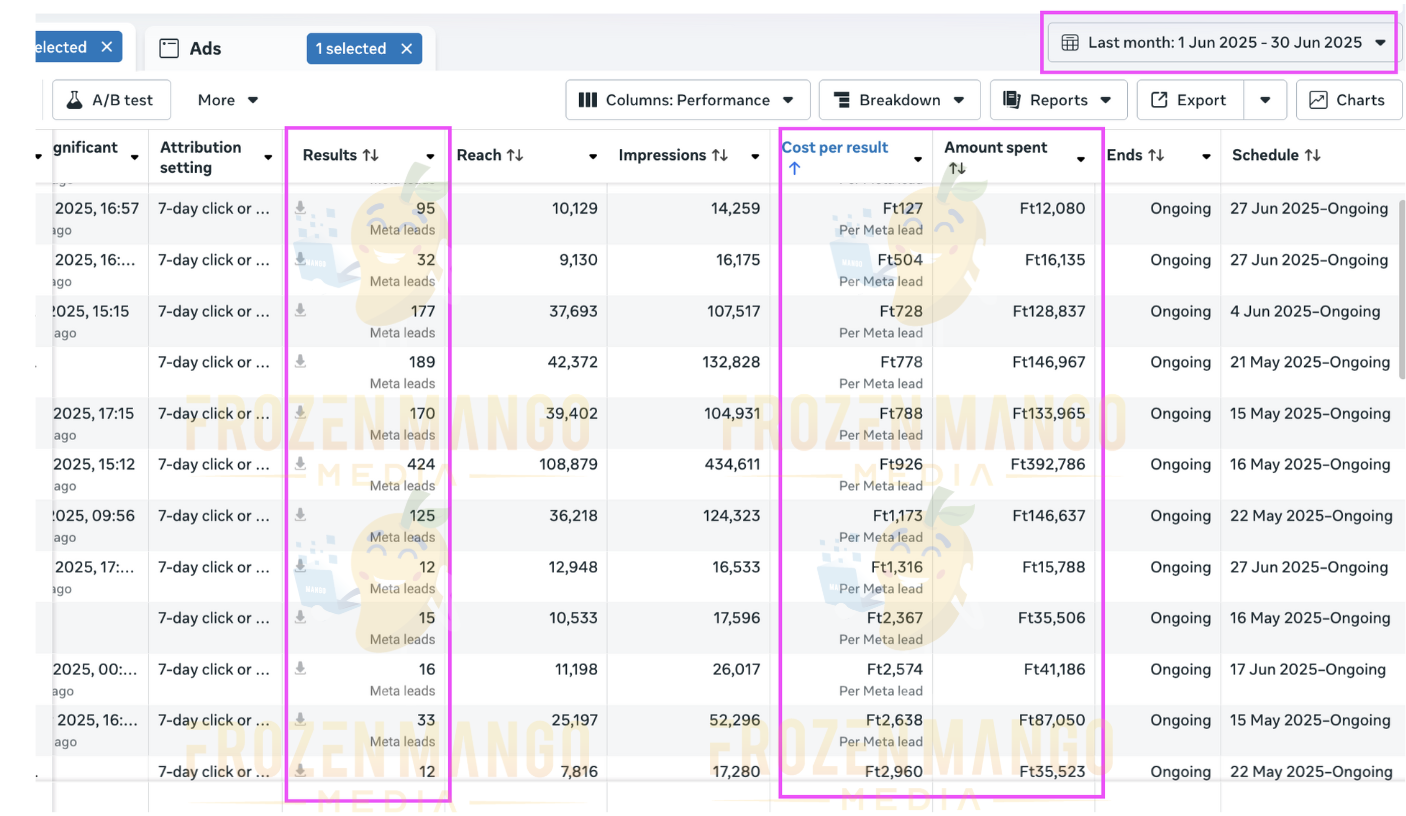
We kept in close contact with the client, told them that cost per lead was higher in certain countries, and asked how strategically important lead generation was in each country. Where countries were of outstanding strategic importance, we didn't stop the more expensive ads but kept refining them.
Why? Because these were strategically important markets for the client's future expansion plans, with significant prestige value as well: the brand had to be present where the client wanted to expand.
Meta ad results in numbers, in 1 month (June)
- Leads interested in the products: 1,531 leads
- Ad spend: HUF 3,267,379
- Average cost per lead among product prospects: HUF 2,134.14
- Job applicant prospects: 107
- Ad spend: HUF 27,868
- Average cost per lead for job applicants: HUF 260

Why did the strategy work?
- Deliberate market selection: we advertised not only where it was cheap but also where the brand wanted a long-term presence.
- Local and international creative adaptation: we always adapted the messages to the cultural and linguistic characteristics of each market. For example, the ad copy addressed the local community directly: Hello [City / Country name].
- Optimised campaign structure: we handled B2B and B2C campaigns separately, in targeting as well as in communication and USPs, because a corporate decision-maker looks for something different from a private individual and responds to different things.
Lesson learnt: CPA isn't everything; other strategically important factors must be considered too.
We didn't judge the campaign's success purely on the cheapest CPA (Cost per Action). It was crucial for the client to expand into international markets where their products are marketable and can be sold at high margins, and to start building a databaseand projecting prestige towards potential clients. Frozen Mango Media contributed to this as a strategic marketing partner as well as a technical one.
Are you also thinking about running international campaigns?
Whether you want to reach a domestic or a foreign audience, we don't just run ads technically, we think in terms of market strategy too, connected to achieving your marketing goals.
Get in touch with us and let's see together what results we can achieve for your brand.