How does lead generation help you seize unique market opportunities?
At the end of 2024, a major announcement shook the Hungarian financial market: until 24 January 2025, a home savings account could be opened for HUF 0 instead of the usual HUF 185,000 entry fee. The offer generated considerable interest, as for Hungarian families and young people a home savings account is one of the most favourable and safest forms of saving.
Our client (https://penzugynet.hu/) approached us to reach as many relevant prospects as possible in a short period who were open to opening a home savings account (LTP). The task was clear: fast, effective lead generation with Meta ads, making sure the prospects were genuine potential clients.
The goal was not only to get as many leads as possible, but also to turn the ad spend into as many genuine, quality business meetings as possible, and from those as many signed contracts as possible.
What is lead generation, and why does it matter?
What or who is a lead, and what does lead generation mean?
A lead, a marketing term, is generally a potential prospect (a person or even a company) who shows genuine interest or an intention to buy or request a quote for a service or product. Put simply, a lead is figuratively a „raised hand”: the potential client signals interest in the offer and wants to learn more. They fill in the enquiry form or give their email address or phone number, and this is worth far more than a simple ad view, because it is the start of a concrete business relationship.
Lead generation is therefore one of the most important tools in marketing: we collect tangible prospects who can become clients, not followers or likes.
The goal is to generate as many relevant prospects as possible who can later become clients.
This can be achieved with various online and offline methods, for example online ads, content marketing, social media campaigns, webinars, attending exhibitions, or even email marketing.
The campaign's goals and challenges
Winning as many genuine prospects as possible in a short time.
Using screening questions to make sure the people filling in the form were truly relevant (for example, interested in home savings and with a housing goal).
Building a cost-effective campaign, as leads are typically more expensive in the financial sector.
We communicated messages that work emotionally (it's free now, there's a deadline) and also give rational reasons to act (saving HUF 185,000).
How did we build the lead generation campaigns?
1. (After consulting the client and reading the brief, of course) A/B testing static creatives and video ads
On Meta, visual appearance is key and significantly affects the CPA (cost per action, i.e. the cost of acquiring one conversion).
We created several creatives and effectively „made them compete” with each other for cost-effectiveness.
In the meantime we asked the client for video ads that explained the essence of the offer briefly and dynamically, with people seeing „a face” throughout, which is a huge trust-building factor.
Call-to-action emphasis: „I'll fill in the form!” „I'm interested!”
In our experience, video ads performed best, because they capture attention far more easily than a plain image or text. A short video can explain the essence of the offer quickly and clearly while having a visual and emotional impact on the viewer. People prefer watching moving, explanatory content to reading long text, so they are more likely to click and more of them share their details.
2. Defining the target audience precisely
We split the campaign into several segments, because not everyone responds to the same message in the same way:
Young couples about to buy a home.
Middle-aged families who want safe savings for their children.
Financially conscious decision-makers who had previously shown interest in similar solutions.
We launched the ad campaigns on Meta (Facebook/Instagram) and tried to segment the targeting as far as the special ad category allows.
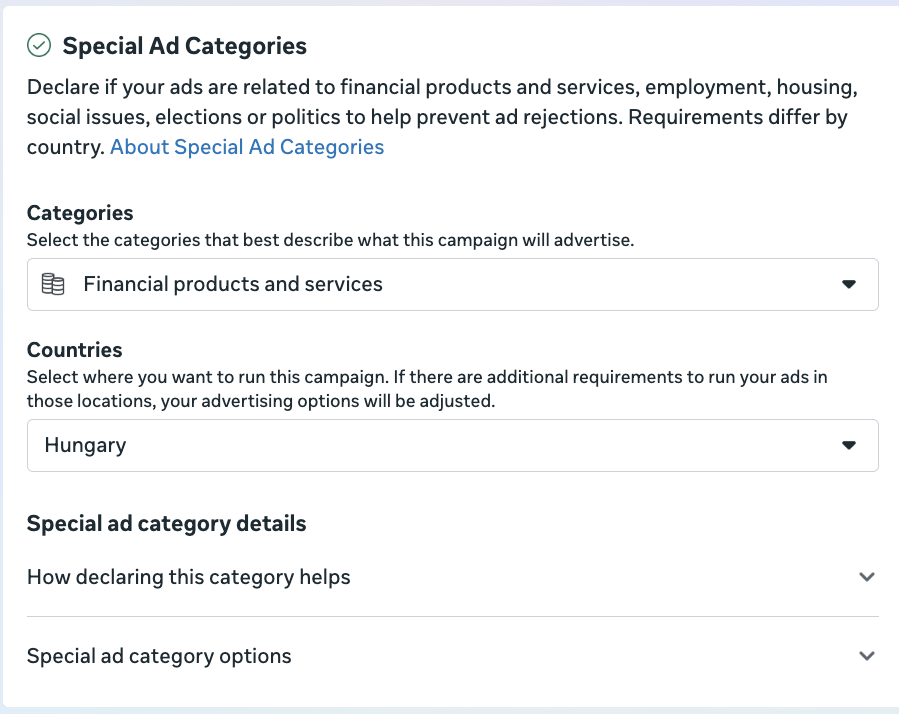
What is the special ad category on Meta, and why does it affect job ads?
Many people don't know this, but when launching ads on Meta (Facebook and Instagram), you have to indicate if the campaign falls into a so-called special ad category. These are areas where Meta applies particularly strict rules to prevent discrimination.
Which topics count as special categories?
Meta currently includes four areas:
- Credit offers and financial services
- Housing (real estate)
- Job ads
- Political and social issues (Meta has in principle banned running such ads from 6 October 2025)
Because finance is a sensitive area on Meta (you cannot select by age, gender, marital status, place of residence or other demographic characteristics), Meta makes it mandatory to tick „Financial products and services” for such campaigns.
What changes if an ad falls into this category?
Limited targeting options: for example, we cannot use age-based or gender-based targeting. (So both men and women must be included in the audience, and users aged 18 and 65+ will also see the ad.)
Narrowed interests: many demographic or lifestyle interests that can otherwise be selected outside the special ad category are not available here.
The algorithm learns differently: with less targeting data available, Meta relies more on campaign performance and the ad creative.
Why does this matter for advertisers?
Because an incorrect category setting often means that:
- the campaign doesn't even start or gets rejected,
- no results come in, because the targeting isn't relevant,
- account sanctions may follow repeated mistakes (e.g. a disabled ad account)
In ad management we pay particular attention to these technical details.
From the campaign planning stage, we design ads and targeting to comply with Meta's rules while still reaching potential applicants, effectively and by the book.
- Geographic targeting based on the place of work (adding +17 km is mandatory)
- Age and interests set within the room we had in the special category: unfortunately, for age it only allows targeting the 18-65+ age group, and relatively few interests.
- A/B testing
- We didn't leave the cost of results to chance. We ran several creative and copy variants in parallel:
- Text and image/video A/B test: which call to action works better
- Creative A/B test: which image or video conveys the message better
- Audience A/B test: which demographic segment brings more relevant prospects.
- Based on the data gathered this way, we continuously optimised the campaign.
- We set up the lead forms with screening questions
- We didn't just collect any prospects: we used a Meta lead form with several screening questions. As a result, the form was filled in by people who were seriously interested in opening a home savings account
The results show in the numbers too

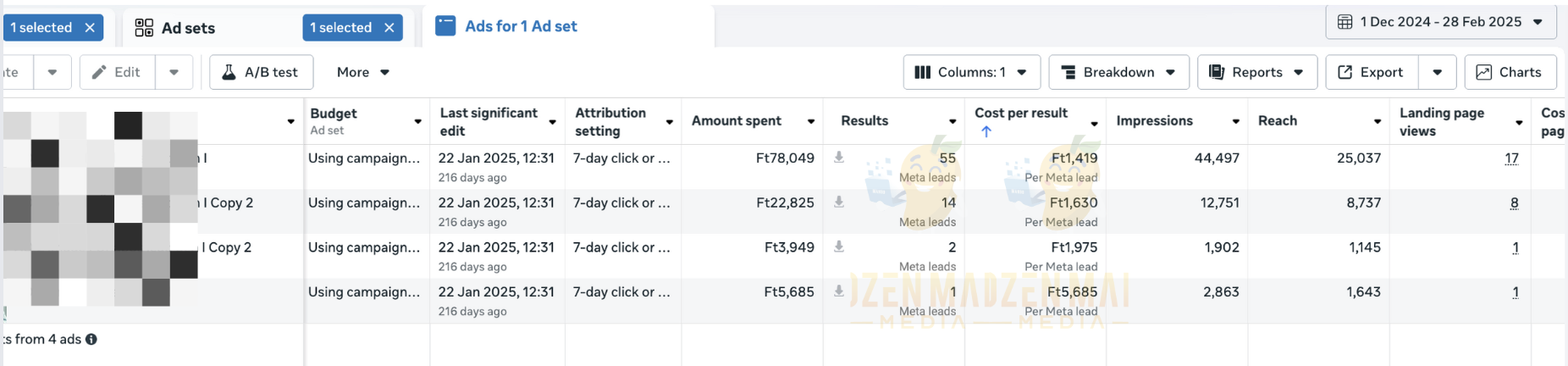
- From HUF 259,544 in ad spend:
- 110 qualified leads came in via the Meta form, after answering several screening questions.
- The campaign also brought 2,422 website visitors, who may become further potential clients, for example through remarketing.
- Cost per lead: HUF 2,368, which counts as outstanding in the financial sector.
- These numbers clearly show that the campaign achieved its goal, bringing in prospects cost-effectively in a short time
Why were video ads and creative A/B testing crucial?
Video content generates longer attention and has a stronger emotional impact. With financial products, a lay audience often doesn't grasp the essence of the offer at first, so moving images help people understand faster.
The A/B tests allowed us to choose the best-performing versions based on data instead of relying on a single direction. This ensured the campaign's flexibility and continuous improvement.
Lessons learnt about lead generation
Lead generation is not the same as clicks or likes: it means a genuine prospect who wants to contact your business
A good creative is crucial: if the ad doesn't speak to people, there won't be any completed forms either.
Optimisation is very difficult without A/B testing: it's the only way to find out which message and audience deliver the best results.
Summary: lead generation is the best investment
This case study is a perfect example that Meta ads are excellent for lead generation, even in the financial sector, where prospects are typically more expensive and the special ad category requirements make our work harder.
We proved it again: with creative ads, precise targeting and continuous optimisation, over a hundred relevant leads can be achieved in a short time while attracting thousands of website visitors, all from a budget that is far from astronomical.
Lead generation is more than a marketing buzzword: it is the most important step in winning business, since every client relationship starts with a prospect.
Need help with lead generation? Get in touch with us: https://frozenmangomedia.hu/ajanlatkeres/