Industry: Education and training
Platform: Google Ads
Goal: Lead generation / increasing course applications
The goal of the partnership
Our client operates in the education and training market and offers many different courses. This makes managing the Google Ads account a far more complex task than launching a few general ads.
In the partnership, the primary goal was more than increasing website traffic. We wanted to reach prospects who were actively looking for a course and ready to apply for one of the advertised courses.
At the very start of the partnership we also set the target CPA, meaning the acceptable cost of acquiring one application. This way we knew exactly what result counted as a successful campaign, and we didn't judge performance by clicks or website visitors alone.
We therefore assessed the campaigns' effectiveness on three key indicators (KPIs):
- How many applications came in,
- How much it cost to acquire an applicant,
- At what ad spend the results were achieved.
What is lead generation, and why does it matter?
What or who is a lead, and what does lead generation mean?
A lead, a marketing term, is generally a potential prospect (a person or even a company) who shows genuine interest or an intention to buy or request a quote for a service or product. Put simply, a lead is figuratively a „raised hand”: the potential client signals interest in the offer and wants to learn more. They fill in the enquiry form or give their email address or phone number, and this is worth far more than a simple ad view, because it is the start of a concrete business relationship.
Lead generation is therefore one of the most important tools in marketing: we collect tangible prospects who can become clients, not followers or likes.
The goal is to generate as many relevant prospects as possible who can later become clients.
This can be achieved with various online and offline methods, for example online ads, content marketing, social media campaigns, webinars, attending exhibitions, or even email marketing.
The challenge was that there were many courses, varying demand and constantly changing priorities, and we had to adapt to all of them
Our client's range includes several courses that differ significantly from one another. The target audience, search volume, seasonality and business priority of each course are different too.
What's more, demand isn't the same for every course, and from a business point of view not every course has the same priority in a given period.
The campaign structure therefore had to do all of the following at once:
- Cover searches related to the different courses,
- Adapt to current course dates and application windows,
- Distribute the budget in the right proportions to ensure the most cost-effective operation
- Respond to the seasonality of the courses as effectively as possible
- Filter out searches that are unlikely to produce genuine applicants.
How did we build our work together?
We started the partnership with a comprehensive Google Ads audit to get an accurate picture of the ad account's starting state, the previous campaign structure, the reliability of tracking and the opportunities for improvement.
This was followed by a detailed brief and an in-person meeting, where we discussed not only the advertising goals but also how the client's business model works, their business priorities, available resources, course start dates and the business importance of each course.
This was necessary because without the right business background knowledge it would not have been possible to build a truly effective campaign structure.
We didn't run the Google Ads account as one general campaign, because that approach could never have delivered so many applications. We segmented the courses by priority, search volume, business importance and current start date.
Throughout campaign management we continuously examined:
- Which courses generate the most applications,
- Which keywords bring in prospects at the lowest cost,
- Where relevant traffic arises but few actual applications,
- For which campaigns increasing or reducing the budget is justified,
- Which search terms need to be excluded,
- And which new keywords or search directions are worth adding to the campaigns.
We didn't make decisions based on the number of clicks alone; in fact, lots of clicks or website visitors on their own don't make an effective campaign.
For us, the real question was how many of the visitors coming from the ads actually applied for a course, and how much it cost to acquire a new applicant.
So in every case we aligned campaign optimisation with actual business results, meaning the number of applications and their acquisition cost.
The results in numbers
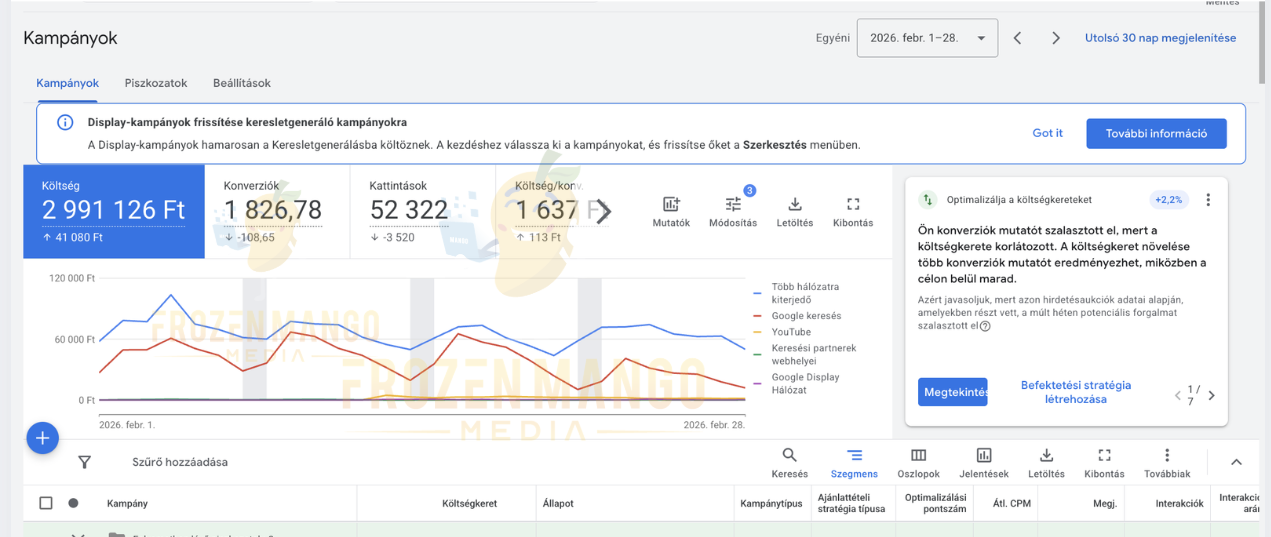
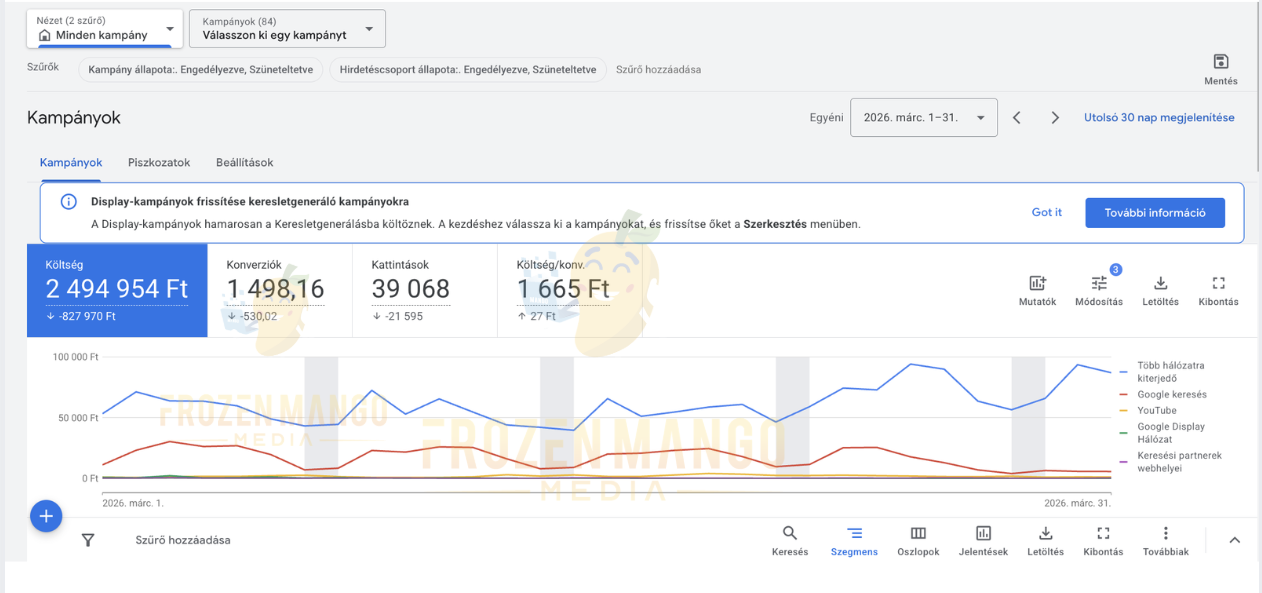
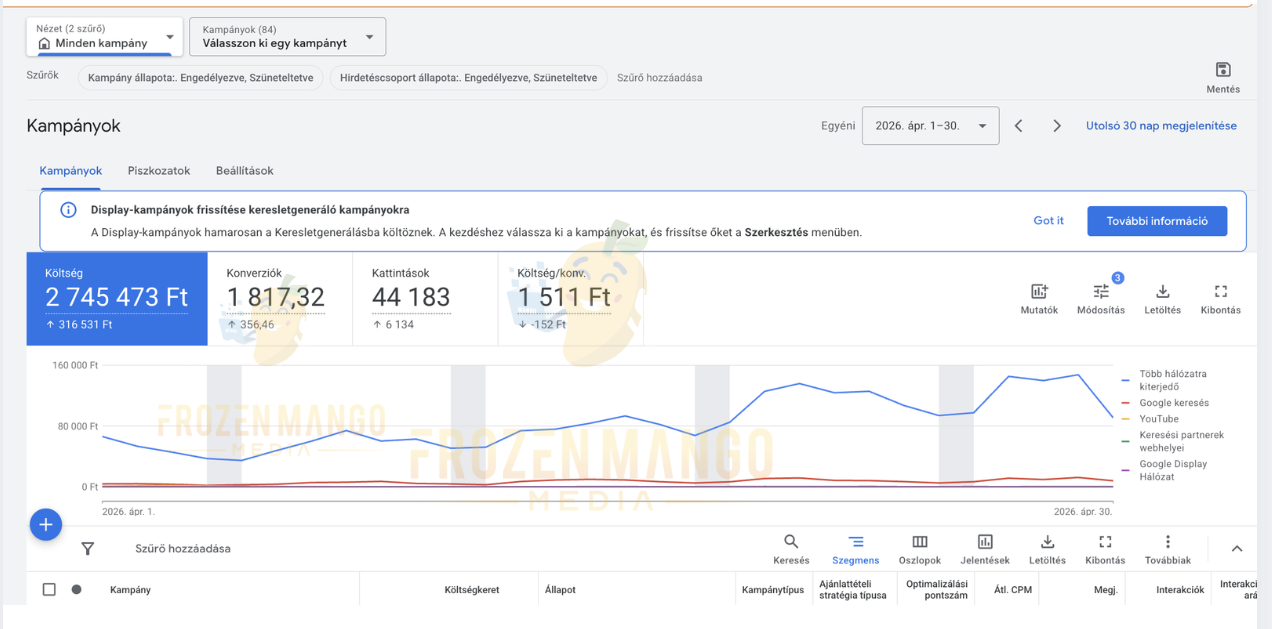
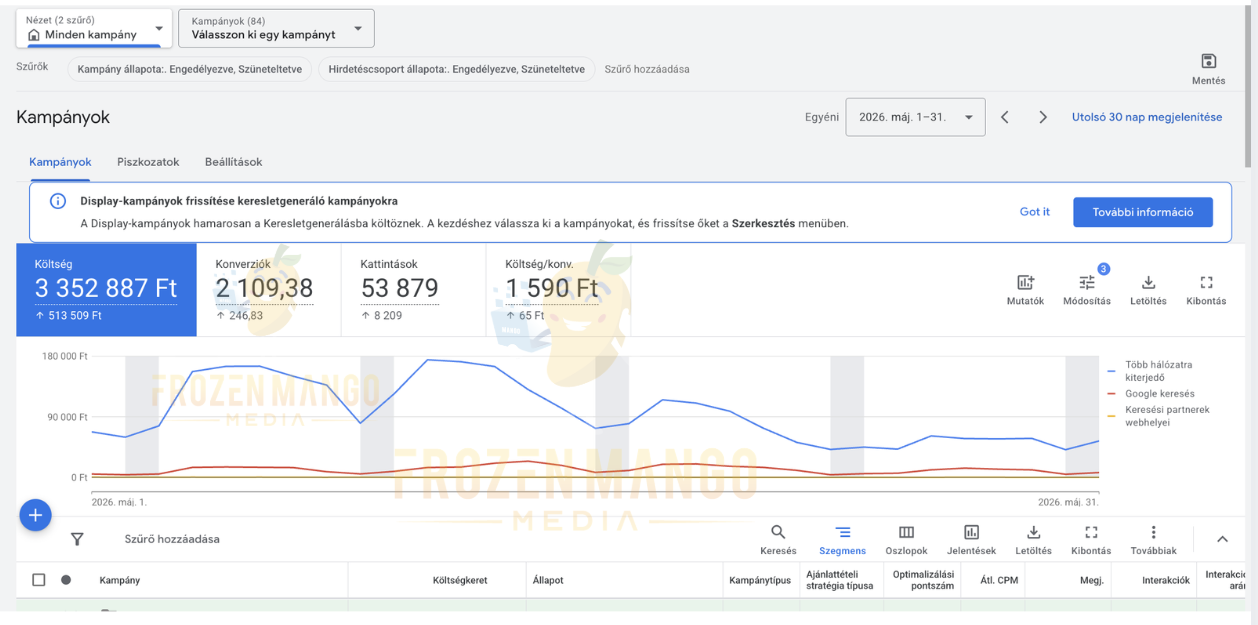
In the five months between February and June 2026, the Google Ads campaigns achieved the following results:
Period | Advertising cost | Applications | Cost per application |
February 2026 | HUF 2,991,126 | 1 826,78 | HUF 1,637 |
March 2026 | HUF 2,494,954 | 1 498,16 | HUF 1,665 |
April 2026 | HUF 2,745,473 | 1 817,32 | HUF 1,511 |
May 2026 | HUF 3,352,887 | 2 109,38 | HUF 1,590 |
June 2026 | HUF 2,539,250 | 1 695,55 | HUF 1,498 |
Total / weighted average | HUF 14,123,690 | 8 947,19 | HUF 1,579 |
Because of the attribution model used, Google Ads can show fractional values for the number of conversions.
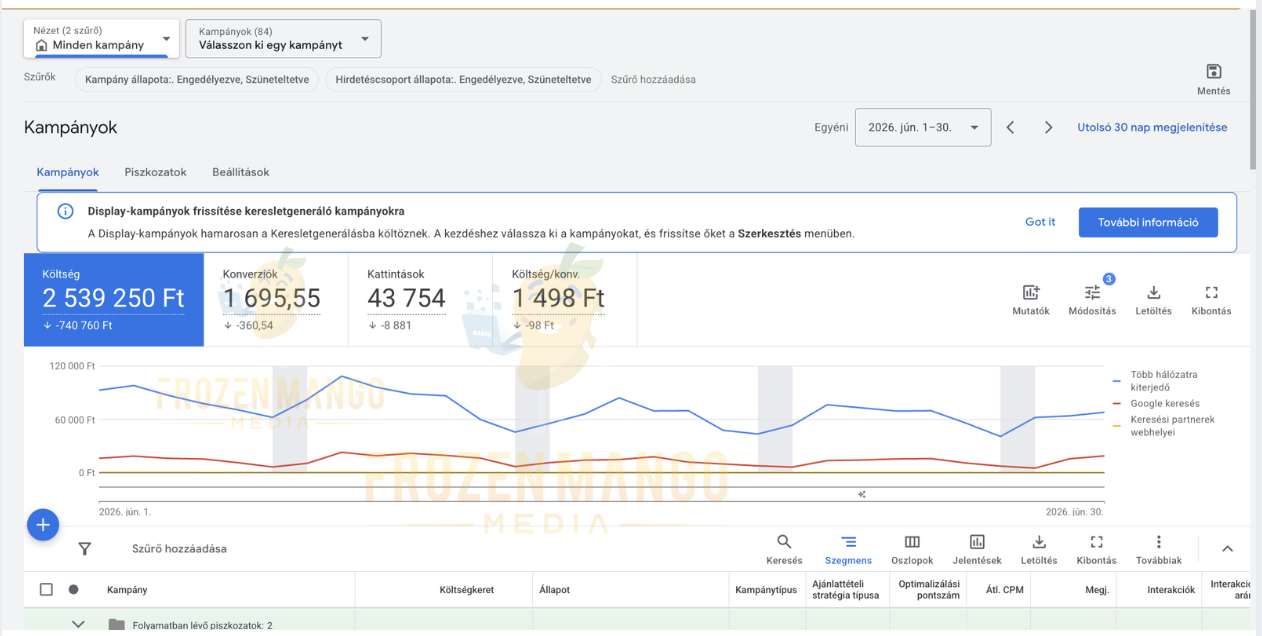
Nearly 9,000 applications in five months
Over the five-month period, the Google Ads campaigns we managed and launched generated a total of 8,947.19 conversions measured as applications .
That's a monthly average of approximately 1,789 applications .
The highest monthly result was achieved in May 2026, when:
- 2,109.38 applications came in,
- HUF 3,352,887 in ad spend,
- at an average cost per application of HUF 1,590.
The May result clearly shows that the campaign system was able to generate a significant volume of leads even with a bigger budget, without the cost per conversion rising disproportionately.
On average, acquiring an applicant cost HUF 1,579
The cost per conversion remained relatively stable throughout the five months: between HUF 1,498 and HUF 1,665 .
This is a particularly important result for a Google Ads account running several courses, different demand levels and numerous campaigns at once. The stable cost per application shows that the campaigns remained under control even at higher volumes.
June delivered the best cost-effectiveness
Of the months examined, June had the lowest cost per application:
- Ad spend: HUF 2,539,250,
- Number of applications: 1 695,55,
- Cost per application: HUF 1,498.
In February the average cost of acquiring an application was still HUF 1,637; by June it had dropped to HUF 1,498.
That's an improvement in cost-effectiveness of nearly 8.5% , which is very significant in results at this level of ad spend.
Compared with May, ad spend in June fell by more than 24%, while the cost per application also improved by nearly 6%. In other words, we won new prospects more efficiently at a lower monthly cost.
What do the results show?
The effectiveness of the Google Ads campaigns didn't come from a single outstanding month. Every month of the five-month period brought a significant number of applications, while the cost per conversion stayed in a stable, predictable range, even as we kept testing new campaigns and ads.
The campaigns' key results:
- HUF 14.12 million in ad spend,
- nearly 9,000 applications,
- an average cost per application of HUF 1,579,
- more than 2,100 applications in the strongest month,
- a cost per application of HUF 1,498 in the most efficient month.
The results show that with the right campaign structure, continuous optimisation and deliberate budget allocation, even the Google Ads system of a business offering many courses can be scaled effectively.
Summary
In this education and training project, Google Ads did more than drive visitors to the website: the campaigns supported the generation of course applications at a measurable and predictable cost.
During the five months of the partnership examined, between February 2026 and 30 June 2026 we generated nearly 9,000 applications, while the average cost of acquiring an applicant stayed below HUF 1,600.
Total ad spend in this period was HUF 14,123,690 .
One of the most important lessons of the project is that in a complex advertising system with many courses, simply launching the campaigns isn't enough.
Achieving results requires continuously tracking changes in demand, business priorities, the quality of search terms, the development of application costs and the seasonality of the courses.
A well-functioning Google Ads system therefore contributes directly to achieving business goals, beyond simply generating traffic.
Shall we talk about your ad campaigns too? Or are you interested in increasing your AI visibility? Get in touch with us